


Pattern recognition is not magic. It grows when you spend enough time with meaningful examples to notice what repeats and what changes.
Chase and Simon’s chess study found that stronger players perceived larger, meaningful structures in real positions. That does not mean chess experts had a universal pattern-recognition superpower. Their advantage was connected to what they had learned in chess. Read the study90004-2).
After completing a project, write down three patterns you noticed and one case that broke the pattern.
Metacognition sounds abstract. In practice, it means checking whether your confidence matches what you can do without help.
Across two studies of college students learning definitions, more accurate judgments of learning were tied to better retention two days later under the study procedure. Read the research.
Before reviewing your notes, answer one question from memory. Compare the answer with the source. Let the gap, not your feeling, decide what needs more work.
In Slamecka and Graf’s experiments, people remembered material they generated better than material they only read. The result is specific to the tested memory tasks, but the practical move is simple: make an attempt before looking. Read the study.
Predict the answer, draft the formula, sketch the layout, or explain the concept before opening the example.
“Create more than you consume” is not a scientifically established ratio. I still like it as a correction. It is easy to finish a video and mistake recognition for ability.
Creation gives you evidence. A solved problem, rough prototype, recorded explanation, or page of notes shows what you can produce without the creator guiding every step.
End each learning session with a small output someone else could inspect.
Solitude is not automatically deep, and collaboration is not automatically distracting. I use solitude when other people’s reactions are arriving faster than my own thoughts.
Give the first twenty minutes of a difficult problem to yourself. Write your own questions and attempted answer before asking a person, search engine, or model.
Childlike playfulness is useful when it means trying variations without needing every attempt to justify itself. It is not the same as avoiding hard practice.
Change one constraint. Make the example smaller, stranger, faster, or visual. Ask, “What happens if I do the opposite?” Then check what the experiment taught you.
In a trivia experiment, high-curiosity states were associated with better immediate and one-day memory for answers and some incidental material. That does not make endless browsing a learning strategy. Curiosity needs somewhere to land. Read the study.
When something catches your attention, write a question that has a checkable answer. Learn until you can answer it.
Across four experiments, walking improved divergent idea generation on the tasks the researchers used. The study did not show that a walk solves every analytical problem. I would use it when I need options, not when I need to verify a calculation. Read the study.
Take a short walk without audio. Carry one question and record the options afterward.
Persistence becomes useful when the problem changes from “I don’t get it” to something you can name. Staying stuck for hours without feedback can rehearse the wrong move.
Before switching tasks, write the exact point where your reasoning stops. If you are just circling, get feedback and return. Our guide to crossing the boredom barrier can help when the urge to switch is the problem.
Flow is not a switch I can demand. I can make it easier to start by shrinking the first action, removing obvious interruptions, and making the next step visible.
Decide what “in progress” looks like before the session begins. If starting is the issue, use the on-ramp in our guide to focus and concentration.
Writing helps when it forces a vague idea into a sequence another person could inspect. In an experiment with bank apprentices, prompts that elicited self-explanations supported transfer under the study conditions. Writing is one way to make that explanation visible. Read the experiment.
Write, “I think this works because…” Then look for the first sentence you cannot defend. Our article on self-explanation gives you a fuller method.
“Polymath” is an identity. Connecting ideas is a practice. The useful move is not collecting topics. It is carrying a model from one field into another and checking where the analogy breaks.
Choose one idea from your main field. Apply it to a second field, then list one useful connection and one place the comparison fails.
Across several studies of disagreement, people higher in intellectual humility were more open to opposing views. That does not mean treating every claim as equally credible. It means recognizing that your current view can be incomplete. Read the study.
Write the strongest evidence that would change your mind. If no possible evidence qualifies, you are protecting an identity, not testing a belief.
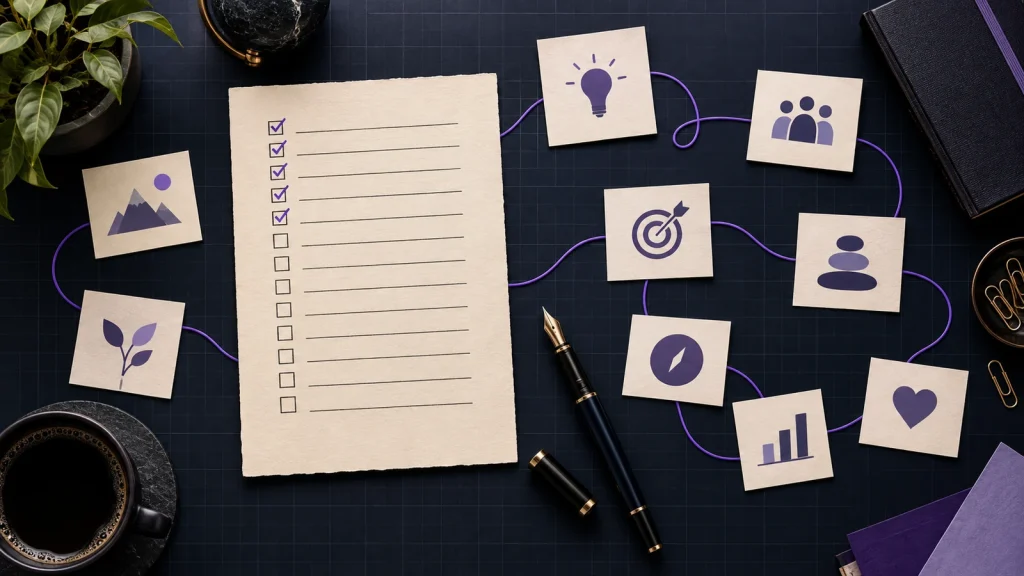
Checking every box does not prove you are a genius. Missing several does not make you unintelligent. The research behind these items comes from specific tasks, and the list combines evidence-backed learning effects with practical working habits.
That is fine. A checklist does not need to diagnose you to be useful.
Review your marks. Choose one item labeled avoiding and practice it for seven days. Make the action small enough to observe: one question from memory, one walk without audio, one written explanation, or twenty minutes alone with the problem.
The label will not make you a better learner. The repetition might.
For more practical ways to learn on your own, explore Level Up Smarter.
Level Up Smarter publishes practical, science-informed strategies for learning faster, focusing longer, and building the skills that matter.
Start Here →