


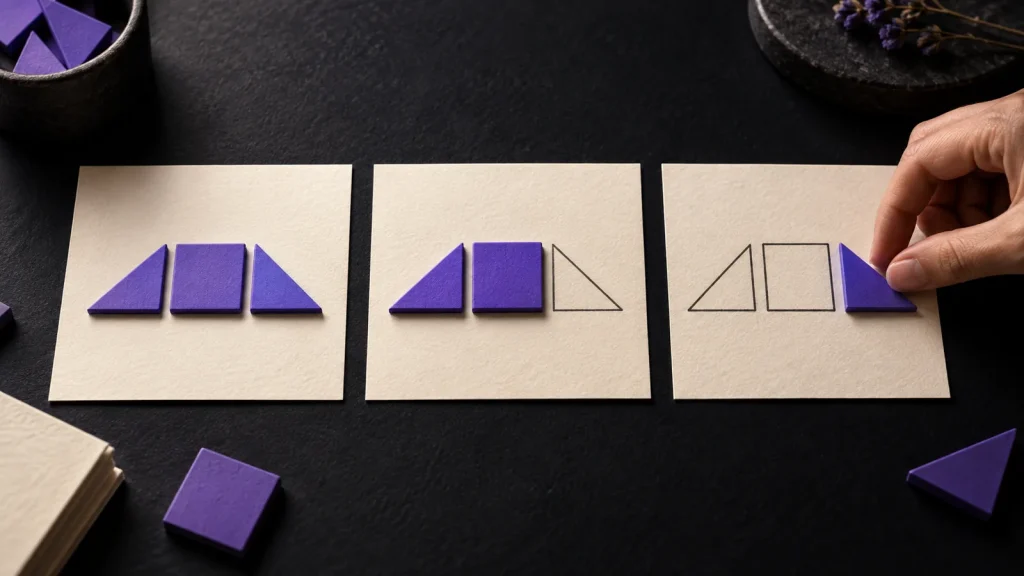
Cognitive load theory treats working memory as a constraint on processing unfamiliar material. One implication is that searching for a solution can consume resources that might otherwise help you understand its structure. A worked example supplies the problem, the steps, and the result, so you can examine how they connect. Renkl and colleagues discuss this rationale in their research on learning from examples.
For a person learning alone, the practical question becomes: Which decisions can the example handle while I learn the decision that matters now?
Suppose your goal is to calculate the cost of a batch of printed cards. The next useful assignment might be multiplying the number of cards by the cost per card. Choosing a spreadsheet template, formatting currency, and building a chart can wait.
You still need to learn those other tasks eventually. You are deciding their order.
If the difficulty is getting started at all, use the focus on-ramp first. This article picks up once you are sitting with the material and need a better-sized learning task.
Tamara van Gog, Liesbeth Kester, and Fred Paas compared four approaches to electrical-circuit troubleshooting: examples alone, examples followed by problems, problems followed by examples, and problems alone. Their participants were secondary students who were novices at those tasks.
Examples alone and example-then-problem sequences produced lower cognitive load during learning and better learning outcomes than problem solving alone. The study supports giving beginners useful guidance; it does not establish that every adult should watch more tutorials. Read the 2011 study.
Alexander Renkl and colleagues tested a more gradual transition. Learners moved from complete solutions through increasingly incomplete examples to independent problems. Across three experiments, this approach helped performance on problems with similar underlying structures. Evidence for more distant transfer was less clear. Removing the final steps first was more favorable than removing the first steps first in their comparison. Read the 2002 paper.
There is no universal example-to-practice ratio hiding in those findings. In two later experiments, Milou van Harsel and colleagues compared shorter and longer sequences. In the longer sequence, all conditions containing examples were more efficient and motivating than problems alone, but only the examples-only condition produced significantly better test performance than problems alone. Read the 2020 study.
The useful conclusion is narrower than “practice immediately” or “keep watching.” The amount and arrangement of guidance deserve attention. Use your own independent performance to decide what comes next.
Here is an original practice exercise for someone teaching themselves spreadsheets. It applies the research; the exact sequence below has not been experimentally validated.
Your project is a simple print-cost calculator. Use these invented practice values:
The finished example has three lines: printing costs $20; the batch costs $30 including setup; the average cost is $0.375 per card. Keep the units next to every value. These are arithmetic inputs, not purchasing advice or real vendor prices.
Before using a tutorial as your example, check its answer. For this one, multiplying 80 by $0.375 should return the $30 total. A beautifully formatted spreadsheet can still contain a mistaken formula.
Start with this question: “How do I turn the total batch cost into an average cost per card?”
That is specific enough to assess. “Understand spreadsheets” is too broad to tell you whether today’s attempt worked.
Keep the earlier calculations supplied. Read the final line and explain why dividing the total by the number of cards gives the requested quantity. If that relationship is unclear, work with the quantities on paper before adding spreadsheet syntax.
Use a second batch with 100 cards, the same printing rate, and the same setup charge. Supply the printing cost of $25 and total cost of $35. Leave the average-cost calculation for yourself.
Enter the formula, predict the unit of its result, and check the answer: $0.35 per card.
If you get $3,500, inspect the operation. If you get a spreadsheet error, inspect the cell references or syntax. Write down which kind of problem occurred. That note identifies a repair more precisely than “I don’t get it.”
For a batch of 60 cards, keep only the inputs visible. Calculate printing cost, add the setup charge, and calculate the average. The answers are $15, $25, and approximately $0.4167 per card.
If that jump is too large, supply the printing cost and finish the remaining two lines. Reopen enough of the example to locate the mistake, then attempt a fresh batch with that support removed.
There is no required timer or number of rounds. Increase responsibility when you can produce and check the calculation. Keep support where the reasoning is still missing.
Now ask: “Why did the average cost per card fall when the batch increased from 80 to 100?”
The printing rate stayed the same. The fixed setup charge was spread over more cards. That explanation matters more than remembering where the division sign went.
Next, consider a different situation: the setup charge doubles when a batch exceeds 100 cards. Does a larger batch still necessarily have a lower average cost? You would need to recalculate. The old conclusion depended on an assumption that has changed.
Use our self-explanation guide when you need help examining why a step works. Here, the purpose is to check whether the support has taught you a usable relationship.
Guidance can also outlast its usefulness. Slava Kalyuga, Paul Chandler, and John Sweller studied how instructional design interacted with expertise. Across three experiments, the most effective format shifted as expertise increased: learners initially benefited from integrated diagrams and text, while more experienced learners benefited when the redundant text was removed. Read their 1998 study.
That does not mean you should delete your reference library. It suggests checking whether the current explanation still serves a purpose.
If you can already build the calculator, stop restarting the beginner tutorial. Try a new requirement. Keep the reference available for the specific gap you uncover.
I don’t want a learning routine whose finish line is “the example looks familiar.” I want a result I can produce, explain, and check when the example is closed.
Feeling overwhelmed does not diagnose the cause. A task may depend on concepts you have not learned, use an unclear explanation, or simply be the wrong task for the time available. Reducing a calculation to one missing step will not automatically solve those problems.
The studies above also have boundaries. They used particular participants, materials, sequences, and tests. The circuit study involved secondary students; the fading study included school and college settings. Applying those results to independent adult projects is a reasoned adaptation, not direct proof of this spreadsheet routine.
Use the method when the work has inspectable steps and a way to check correctness. For an open-ended task such as developing a business strategy, begin with a narrower component whose quality you can evaluate. A worked example cannot choose your goals or resolve uncertain evidence for you.
For your next session, choose one correct example and one part you will do yourself. Finish with a changed problem. Record the support you still needed and the decision you could make without it.
That record gives the next session a starting point.
Explore more practical learning methods at Level Up Smarter, and use the one that helps you make your next independent attempt.
Level Up Smarter publishes practical, science-informed strategies for learning faster, focusing longer, and building the skills that matter.
Start Here →Plus one short, useful email from Quincy most weeks on learning faster, focus and the habits that hold it all up. No spam, unsubscribe in one click.

The Level Up list
Learning faster, focus, sleep and the habits that hold it all up, from Quincy. You start with the Consistency Equation. No spam, unsubscribe in one click.

Free guide
Get the Consistency Equation free, plus one short email most weeks on learning faster and sticking with it.