

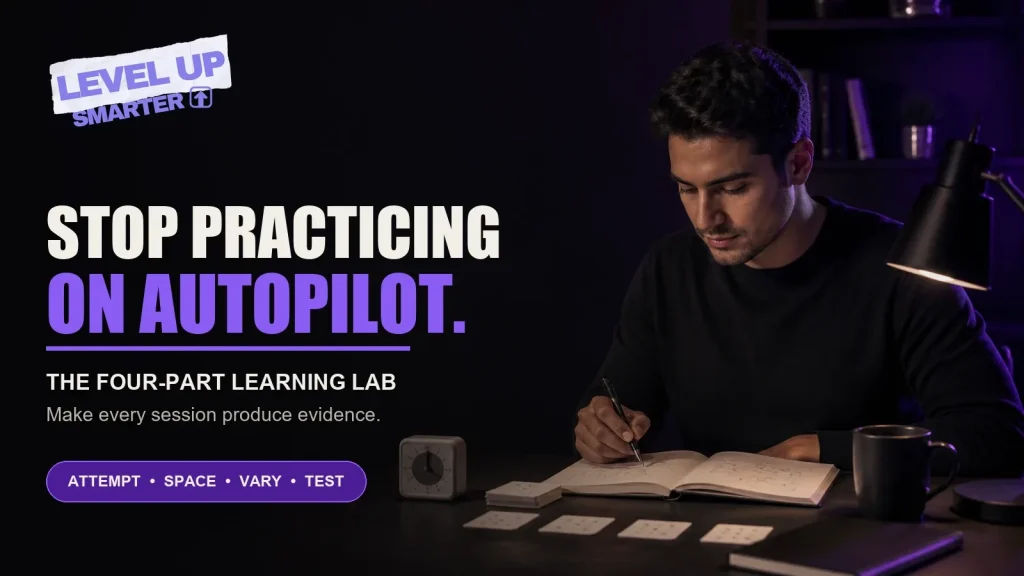
Why smooth practice can hide weak learning, and how to make every session produce evidence.
The first switch is simple and uncomfortable.
Try to produce the answer before you review it.
That could mean:
In a well-known retrieval experiment, Jeffrey Karpicke and Henry Roediger had university students learn foreign-language vocabulary. Once an item had been recalled correctly, more studying did little for delayed recall. Repeated retrieval made a large difference.
The lesson is not that reading has no value. You need input before you can retrieve anything.
The lesson is that recognition can impersonate mastery.
When the page is open, the answer feels obvious because it is sitting in front of you. Closing the page removes that support. Now your memory has to do the work.
This is why I treat a failed attempt as information.
It shows me the exact part of the skill that is not yet available without help.
If you want a deeper breakdown of this effect, start with our guide to active recall versus rereading.
For this learning lab, use one rule:
The second switch is time.
Most of us treat stopping as the enemy of momentum. We finally get into the material, so we keep pushing until the session is over.
That can improve performance while everything is still warm. It does not necessarily tell us what will be available later.
Spacing creates a new test: can you reconstruct the knowledge after some of the immediate familiarity has faded?
Nicholas Cepeda and colleagues reviewed 317 experiments on distributed practice. Across that large body of work, spreading learning episodes over time improved long-term retention compared with massing them together. The best gap was not one universal number. It changed with how long the learner needed to retain the material.
That matters because “use spaced repetition” is incomplete advice.
Spacing is not a special flashcard setting. It is a decision to return after memory has had time to become less convenient.
You can use it for almost anything:
The point is not to wait until you have forgotten everything.
The point is to stop relying on the temporary fluency created by nonstop repetition.
Before you end a session, put the next return on your calendar. If the return is not scheduled, “I will revisit this later” usually means “I will start something new instead.”
The third switch is variation.
Repeating the identical task can make you efficient at one exact version of the task. Real life rarely holds the conditions still.
If you are learning to present, the questions change. If you are learning design, the brief changes. If you are learning a language, the speaker, speed and context change.
The useful question is:
In a Johns Hopkins study of skill reconsolidation, participants learned a sensorimotor task and returned after the skill had time to consolidate. Some practiced the same task again. Others practiced a subtly varied version. The variable-practice group showed greater improvement.
That result came from a controlled motor task, so I would not turn it into a promise that random changes make every skill grow faster. The practical idea is narrower: once you can perform the basic version, introduce a small variation that requires adjustment without turning it into a completely different task.
Examples:
Change one variable, not five.
That gives you a useful comparison. If performance falls apart, you know which condition exposed the weakness.
This is where practice becomes a learning feedback loop: attempt, observe, adjust and repeat.
The fourth switch is movement.
Exercise is often marketed as if one workout unlocks a universal “learning mode.” The evidence is more interesting and less absolute.
One controlled study found that a single bout of moderate aerobic exercise supported short-term learning in simple visual and motor tasks. Other work has found benefits under particular combinations of timing, intensity and task.
But results do not always replicate. A later study of young adults found that high-intensity cycling did not improve retention on its motor task compared with rest. The researchers noted that exercise effects may depend on the learner, fitness level, task and protocol.
So I would not tell you that a 15-minute workout guarantees better memory.
I would test a smaller claim:
Try a brisk walk, easy cycling or another form of movement that is already safe and familiar for you. Then compare the quality of the session with a normal day.
Track something concrete:
Movement is a variable in the experiment, not a requirement for learning.
If exercise is not appropriate for you, skip it. The first three switches still give you a complete practice loop.
Here is how I would put the four switches into one session.
Take five to ten minutes to move, if that is safe and useful for you.
Do not make the movement so intense that fatigue becomes the new problem.
Spend 20 minutes with the material or skill.
Choose one bounded outcome. Do not try to “learn the whole topic.”
Remove the instructions.
Write, explain, solve or perform as much as you can without help.
Mark the first point where you get stuck.
Reopen the source and repair that specific gap.
Then close it and try again.
Schedule the next session after a real gap.
Keep the learning goal, but change one condition.
Then compare the two attempts.
That is the full lab:
You do not need a complicated dashboard.
At the end of each session, record three lines:
Those three answers turn practice into evidence.
They also protect you from a common trap. When a session feels difficult, you may assume it failed. Your log can show the opposite. The difficulty may have revealed a gap, and the next attempt may show that you repaired it.
Smooth practice feels good.
Useful practice tells you the truth.
Learning faster does not always mean moving through material faster.
Sometimes it means discovering sooner that you cannot retrieve the idea, that your practice does not transfer, or that the skill disappears after a day away.
That information can feel like failure.
It is actually direction.
So the next time you sit down to learn something, do not build a longer study session.
Run a smaller experiment.
Attempt before you look. Leave before familiarity fools you. Return with one condition changed. Test whether movement helps you arrive ready.
Then record what happened.
That is how practice stops being time spent and starts becoming a system you can improve.
Educational note: This article discusses general learning research. It is not medical advice or individualized exercise advice. Choose movement appropriate to your health and abilities, and consult a qualified professional when needed.
Level Up Smarter publishes practical, science-informed strategies for learning faster, focusing longer, and building the skills that matter.
Start Here →Plus one short, useful email from Quincy most weeks on learning faster, focus and the habits that hold it all up. No spam, unsubscribe in one click.

The Level Up list
Learning faster, focus, sleep and the habits that hold it all up, from Quincy. You start with the Consistency Equation. No spam, unsubscribe in one click.

Free guide
Get the Consistency Equation free, plus one short email most weeks on learning faster and sticking with it.