




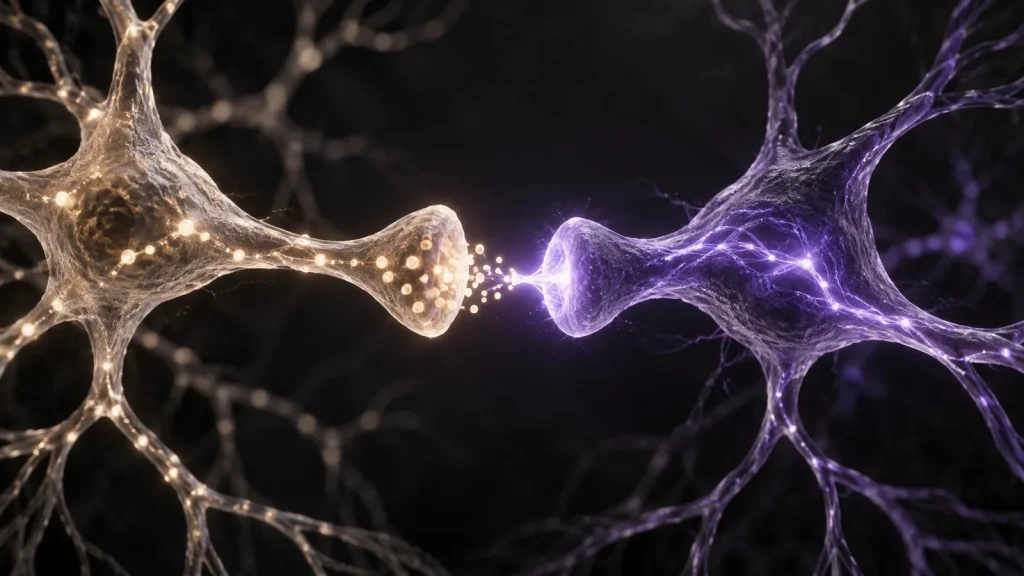
The sending neuron is called the presynaptic neuron.
When its axon fires, it releases the neurotransmitter glutamate into the small gap between neurons, called the synapse.
Glutamate can bind to two important receptor types on the receiving neuron:
These receptors respond to the same neurotransmitter, but they do different jobs.
AMPA receptors open quickly when glutamate binds to them.
Positive ions flow into the receiving neuron, making its interior less negative. This change in electrical charge is called depolarization.
This creates an excitatory postsynaptic potential, or EPSP.
In simple terms, the receiving neuron becomes more likely to fire.
Glutamate can also bind to NMDA receptors, but at resting voltage, the NMDA channel is blocked by a magnesium ion.
This means glutamate binding alone is not enough.
For the NMDA channel to open, two conditions must occur:
This is why the NMDA receptor is often described as a coincidence detector. It detects when presynaptic activity and postsynaptic activation occur together or within a closely coordinated time window.
When AMPA receptor activity depolarizes the receiving neuron, the voltage-dependent magnesium block is pushed out of the NMDA channel.
Now the NMDA receptor can conduct ions, including calcium.
Calcium enters the receiving neuron and acts as an important internal signal.
It tells the cell that this particular connection was active during a meaningful moment of neural activity.
Calcium activates several signaling pathways inside the neuron, including pathways involving calcium/calmodulin-dependent protein kinase II, or CaMKII.
These pathways can increase the activity of existing AMPA receptors and help move additional AMPA receptors into the cell membrane.
Now, the next time the same presynaptic neuron releases glutamate, there are more AMPA receptors available to respond.
The result is a larger EPSP.
The same incoming signal now produces a stronger response from the receiving neuron.
This strengthening of a synapse is called long-term potentiation, or LTP.
LTP is one of the best-studied cellular mechanisms related to synaptic plasticity, the brain’s ability to change the strength of its connections.
It does not explain every detail of learning or memory, but it helps explain how repeated, coordinated activity can make a neural pathway easier to activate in the future.
Simply seeing information once is not the same as strengthening a useful neural pathway.
Learning becomes more active when you:
Reading may introduce the information, but retrieval, explanation, and application force your brain to reactivate the pathway.
If you want to turn that principle into a study method, start with active recall instead of another pass through your notes.
That repeated activation is what makes knowledge easier to access later.
This is not a story about “more glutamate is always better.”
The amount, timing, location, and duration of neural activity matter. Controlled calcium signaling can support plasticity, while excessive or prolonged NMDA activation can damage neurons.
The goal is not to overstimulate the brain.
The goal is to give it meaningful information, focused attention, active practice, and enough recovery to adapt.
Your brain is constantly deciding which connections deserve to become stronger.
The more deliberately you activate a useful pattern, the easier that pattern may become to access in the future.
Neurons that fire together wire together, but active learning gives them a reason to fire together in the first place.
Educational note: This article explains a cellular mechanism involved in learning and memory. It is not medical advice, and it is not a claim that any specific supplement directly increases NMDA or AMPA receptor activity.
Physiology, NMDA Receptor, NCBI Bookshelf
CaMKII: A Central Molecular Organizer of Synaptic Plasticity
Level Up Smarter publishes practical, science-informed strategies for learning faster, focusing longer, and building the skills that matter.
Start Here →