


My reality: blocked practice feels like progress to me too. Ten problems of the same type in a row, and by number six I am flying. That speed is the trap. By number six I am no longer deciding what kind of problem I am looking at. The page already told me.
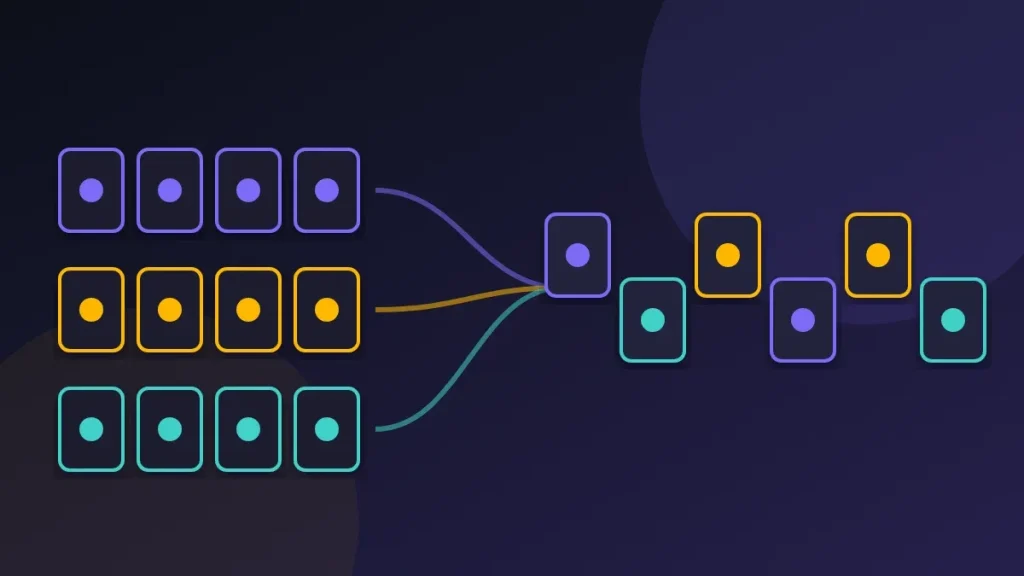
Blocked practice looks like this: AAAA, BBBB, CCCC. You learn one method, then drill it until it feels automatic, then move on.
Interleaved practice looks like this: A, C, B, A, B, C. Same problems, same total amount of work. Only the order changes.
That one change adds a step blocked practice quietly removes. Before you can solve the problem, you have to figure out which method it calls for. In real life, nobody labels the problem for you. A spreadsheet does not announce “this is a lookup.” A data set does not tell you which statistical test it needs. A client email does not say “use the objection script from chapter three.” Choosing the method is half the skill, and blocked practice never trains it.
Nate Kornell and Robert Bjork asked people to learn the styles of different artists from examples of their paintings. One group saw each artist’s paintings back to back. The other saw them mixed with other artists’ work. Then everyone got paintings they had never seen and had to name the artist.
Mixing won. Learners who saw the artists interleaved were better at classifying new paintings.
Here is the part I keep coming back to. Participants rated the back-to-back schedule as more effective, even after their own test results had shown the opposite. The fluent feeling of blocked study was convincing enough to overrule the evidence of their own scores. Read the study.
That is the whole problem with judging practice by how it feels. You cannot trust the feeling here. You have to test.
Doug Rohrer and Kelli Taylor started from an observation about textbooks. Most practice sets contain problems from the lesson you just finished. A few textbooks shuffle problems from many earlier lessons into each set.
In one of their experiments, college students learned to solve several types of problems. Then they practiced either blocked by type or randomly mixed. When the students were tested a week later, the researchers described performance after mixed practice as vastly superior. Read the study.
A week later is the number that matters. Anything looks good the same afternoon.
This is the part most summaries skip, and it is the part that keeps you from wasting a month.
Matthias Brunmair and Tobias Richter pulled together 59 studies on interleaved learning. Across all of them, interleaving had a moderate advantage over blocking (Hedges’ g = 0.42). But the average hides a wide spread:
They also found that interleaving helped most when the categories were similar to each other, when examples inside a category varied a lot, and when the material was more complex. Read the meta-analysis.
So interleaving is not “shuffle everything.” It is a tool for one specific job: learning to tell similar things apart. If two methods, styles or problem types are easy to confuse, mix them. If the things you are learning are not competing with each other, mixing just adds noise.
These steps are my application of the research, not a protocol anyone tested as written.
Blocked practice gives you a clean signal of improvement. Your speed climbs. Your errors drop. You walk away feeling capable.
Interleaved practice takes that signal away. Every problem starts with a small moment of “wait, which one is this?” You make more mistakes, and some of them are the embarrassing kind where you used a perfectly good method on the wrong problem.
That moment of doubt is the skill being trained. The Kornell and Bjork result is a warning about how strongly the opposite feeling can mislead you. The same logic shows up in active recall versus re-reading: the strategy that feels smooth is often the one doing less.
If you are stuck at the same level for weeks, a blocked routine might be part of it. I wrote about that pattern in what actually breaks a learning plateau, where mixing the order is one of several levers.
The research does not show that interleaving improves every kind of learning. The meta-analysis found no clear benefit for expository text and an advantage for blocking with words. Much of the evidence comes from category learning and math problems, often with college students in short experiments.
It also does not tell you the ideal ratio, the ideal number of methods to mix, or how long a mixed session should run. Those choices are yours, and you should adjust them based on what your delayed checks show.
When the hard part of a skill is choosing the right approach, practice choosing. Learn each method on its own first. Then mix the methods you confuse, hide the labels, name the method before you solve and judge the result days later instead of minutes later.
This week, take your next practice set and shuffle in five problems from an earlier topic you think you already know. Then see how many you can identify before you solve them.
If you want a full system for structuring practice like this on your own, explore Learning to Learn.
Level Up Smarter publishes practical, science-informed strategies for learning faster, focusing longer, and building the skills that matter.
Start Here →Plus one short, useful email from Quincy most weeks on learning faster, focus and the habits that hold it all up. No spam, unsubscribe in one click.

The Level Up list
Learning faster, focus, sleep and the habits that hold it all up, from Quincy. You start with the Consistency Equation. No spam, unsubscribe in one click.

Free guide
Get the Consistency Equation free, plus one short email most weeks on learning faster and sticking with it.